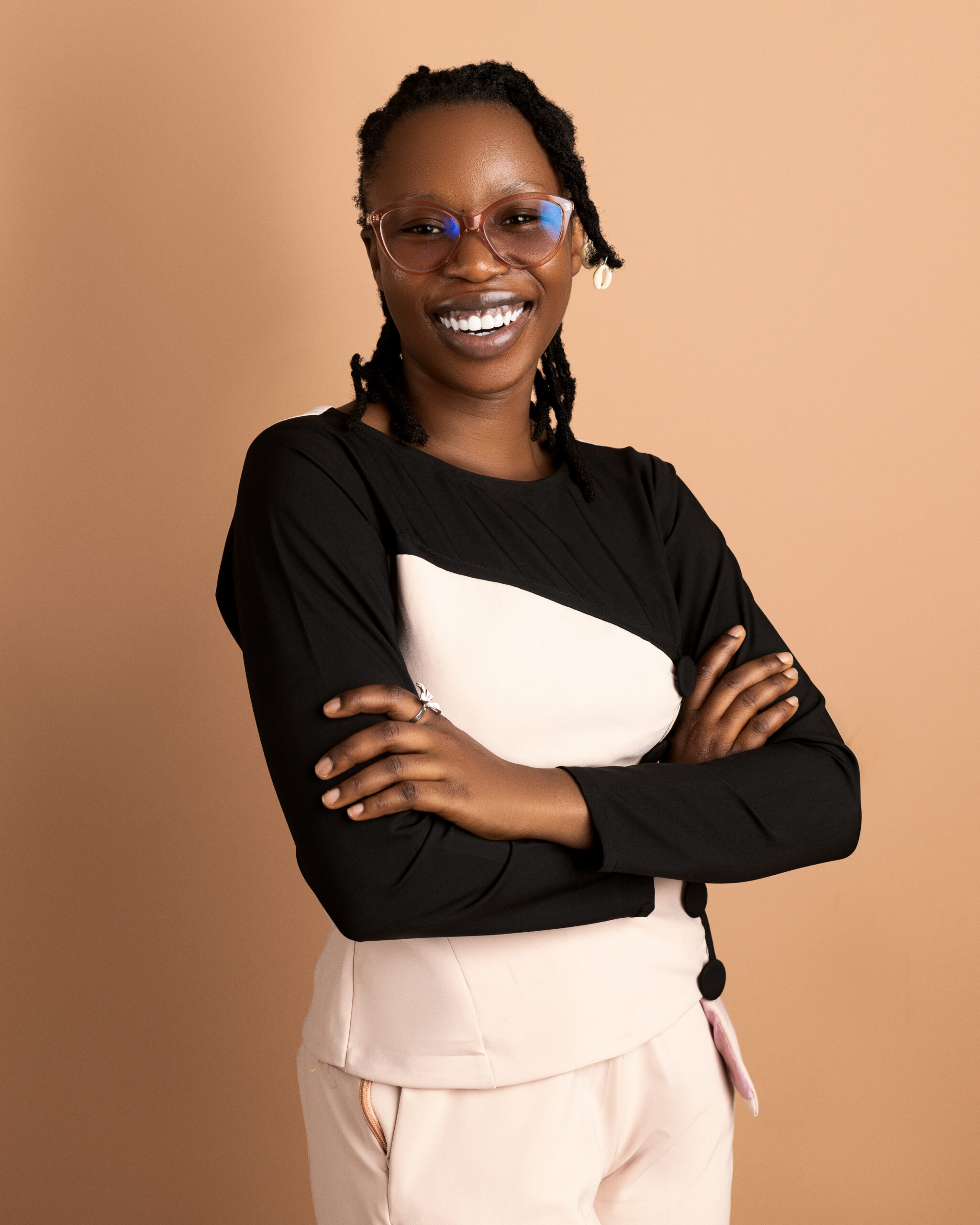
1. Let’s start with a little introduction. Who is Joy Offere?
Can you tell us about yourself, where you’re from, and how you would personally describe yourself beyond your titles?
Hello, thanks for asking. My name is Joy Offere, most people refer to me as Offere, which means light. I am from Northern Cross River, from Ogoja, but was born and raised to a large extent in Calabar.
I am first a Child of God, and then, I am a beautiful and resilient human. (This is not one of those episodes of strong women, this and that, No! I don’t glorify exhaustion, because I believe that every human deserves ease).
2. What was your earliest memory of writing?
Was there a specific moment, story, or experience that made you realize writing was something you wanted to keep doing?
Growing up, my dad would tell me so much about journalism, and written documentary, also, my grandfather would engage me in intellectually stimulating conversations about politics and Christianity.
This combination created a repository of justice, discipline, and morality in my mind.
I would first say I wanted to be an English teacher because I would not just write so well, I would empower others to do the same. This was in Primary 3. I also got into high school, and my aunt,(my then English teacher), who I didn’t know was transferred to my school, read an entry I had submitted to my school journal, demonstrating the need for healthy lungs and discouraging high school leavers from engaging in drug abuse and pricesly smoking.
I still remember how her excitement was greeted with pride because she saw her tiny niece coming out of the crowd with the best-written narrative essay, and she was made the school’s anti-smoking ambassador. I guess she would have said my shayla if it were today 🙂
3. You wear many hats — poet, writer, software engineering student, and tech founder.
How do you manage to balance these different parts of your life without losing your sense of self?
All these parts of me are independent, but somehow still knitted into each other.
For Poetry, it was first a way of expressing my creative freedom, connecting with friends, and articulating my thoughts, or even literary describing the world I want, from the antecedents of my experience.
Poetry was life to me until I lost Jemi. I noticed my art became an expression of grief, and I didn’t want to be a dark poet, so I stopped writing in 2022. This changed a few months ago, in April, when one of my three closeted friends was getting married, and their love story was one I was grateful for, and one of the ways I could demonstrate that was through my art.
I never thought I would write a love Poem, well, now you know a love poet:<)
Also, I haven’t written in a while, so the artistic part of me is on a sabbatical.
I am currently focused on my academics and building Shenovate, and I block a significant amount of time on my calendar to do deep work, connecting with people of shared vision.
I find my sense of self in God, my purpose, and nature. It keeps me grounded, a walk in a park, a flight in the sky, or seeing a girl progress through our initiative, lightens my heart, and whenever I feel overwhelmed, I retrieve into myself and stay for my high recover period, because as high performers we also need high recover period too.
And that’s where coming home and to Nigeria comes in, knowing I am loved and genuinely cared for by family and friends is a gift I don’t take for granted.
4. Let’s talk about Shenovate.
What inspired you to start this initiative, and what has the journey been like so far?
Is there a part where I can exhale before I continue? Because I’ll need that.
The inspiration stems from a first-hand experience, where I was interested in learning and I could not afford the cost of acquiring those skills; however, I was aware of the potential I could develop and a few contributions I could make to impact the world.
It was also a Question of after “Technovation, what next? Technovation is a Global organization in the US that encourages girls to build mobile applications that solve real-world problems in their communities, under the age of 18. A lot of girls where I come from would graduate high school around 16, could take gap years, learn a trade, and luckily venture into tech or get married, while there were a few girls who wanted to learn, they were the financial burden or the gender factor, these continually widen the gap.
And so this gave our mission a defining moment, “Bridging the Gap in Technology by empowering girls and young women between the ages of 9-35 with STEM skills and confidence to pursue career opportunities and leadership roles in the Tech Ecosystem.”
The Journey had been characterised by growth, and glows, we had our struggles, especially with securing funding and implementing projects, expansion, and all.
However, we have tremendously grown, and have had projects in 12 countries on the African continent and over 10,000 girls impacted across the world.
I am very grateful to my team because all of the successes we have recorded would not have been possible without them.
It has ultimately been a journey of Learning, and iteratively so. If it were software, I’d say we are using the classical waterfall model.
5. You’ve been honored with several recognitions, including the Diana Award.
How did that feel, and what did that win mean to you personally and professionally?
I felt humbled and honored, as the purpose of the award is to recognize the highest honor for young individuals who have gone above and beyond in humanitarian services and social action.
But most importantly, it is a call for us to do more, and an opportunity to amplify the impact of our work at Shenovate Initiative.
I also feel that these awards are proof, and I hope that black girls from underserved communities like mine can see what it looks like to dream big, chase that dream, and carry their village along.
6. Grant writing is an underrated art.
You’ve been able to write grants and secure funding for Shenovate. Can you walk us through your approach to strategic writing for grants and partnerships?
Communication for impact is an art, I think people should learn.
Think of writing a grant like communicating your vision and convincing a donor to see that vision by the prospective and potential impact.
Another strategy would be finding common ground and telling your story, which would be a conduit through which your progress can be compounded and one thing about compounding interest is that the result is always bountiful, so don’t give up if you are yet to secure a grant, keep investing your big break will come.
7. Tell us about your education journey.
What made you choose African Leadership University, and what’s one challenge you’ve faced as a student that changed you?
The African Leadership University prioritizes mission over majors, and I think that is what expanded my interest, and even as a student, you are implored to be immersed in your mission. As you come into school, you are asked to think of an African problem you want to solve through the course of your education and gain hands-on experience.
I think I have had several holistic experiences as a student, which have allowed me to experience different dynamics that shape me and my responses to life in general.
There have been moments where we needed to learn, relearn, and unlearn certain perspectives, and that in itself is wholesome. As an ALU student, we “Do Hard Things,” so you might understand if I have become more solution-oriented than dwelling more on challenges, because none come to mind that I can discuss distinctly.
8. You’ve achieved quite a lot already, but we’re sure it hasn’t always been easy.
What’s the most difficult thing you’ve ever had to write, whether it was personal, professional, or emotional?
One of the most difficult things I’ve ever attempted to write is my memoir. Every year, I tell myself, “Next year is the year,” and yet I never quite begin. I believe part of the hesitation stems from living in a time where stories can easily be misunderstood or taken out of context. It takes a great deal of tenacity to bring the experiences etched on the table of your heart into the public space.
Still, I hold on to the hope that one day, I’ll not only write it, but sit down to read it, and be proud of how far I’ve come.
9. You’re a young woman making a name for yourself in a male-dominated field.
Have you ever felt pressure to shrink or shift parts of your identity? How do you stay confident and authentic?
Yes, I have felt that pressure in subtle and not-so-subtle ways. There have been moments when I questioned whether my voice was too bold, my presence too visible, or my ideas too ambitious for the spaces I found myself in. But over time, I realized that shrinking myself only served to dim the very light that made me unique.
What keeps me grounded is remembering why I started — to be the kind of representation I once needed. I stay confident and authentic by embracing all parts of who I am: a young woman, a Nigerian, a tech innovator, and a storyteller. I surround myself with people and communities that affirm my identity, and I remind myself that making space for others starts with being brave enough to take up space myself.
10. What’s one book that has changed your life and why?
Can I say two? The Light We Carry by Michelle Obama and The Bright Side of Rejection by Victor Ibeh have both deeply shaped me, each in its way.
From Michelle Obama’s book, I learned to recognize my light — that innate strength, ability, and purpose — and to be intentional about sharing it with others. That act of sharing creates a ripple effect, a conglomerate of torchbearers lighting the path for others to find and shine their own light. It taught me that our power multiplies when we pour into others.
On the other hand, the Bright Side of Rejection offered a necessary balance. It helped me understand how to navigate a world where rejection is often inevitable. It didn’t teach me to avoid pain, but to understand it, grow through it, and protect my light despite it. Together, these books showed me how to remain grounded, strong, luminous, and unshaken by external forces.
11. For young writers reading this who are still unsure of their path,
What advice would you give to help them gain clarity or courage to pursue their writing dreams?
There will come a moment in your life, “ an epiphany” that brings everything into focus. When that moment comes, preserve it. Let it become your north star and guiding light, especially on the days when the path feels unclear.
Ask questions, lots of them. Be curious, not just about writing but about the world around you. Set goals that stretch you, and most importantly, be authentic in your art. Your readers won’t just consume your words — they will build a relationship with you through them. So invest in the community your writing creates. That’s where the real magic begins.
12. What’s next for you, Joy?
Are there any upcoming projects, writing, tech, or community-related, that we should keep an eye out for?
Looking ahead, I plan to specialize in Educational Technology by contributing to Digital Learning Strategy and Inclusive Innovations that advance opportunities on a global scale.
Other than these, you’ll have to wait around to find out!
Truly inspiring Joy!
Keep it up, you’re doing amazing. I can’t wait to find out what you have in store for us!